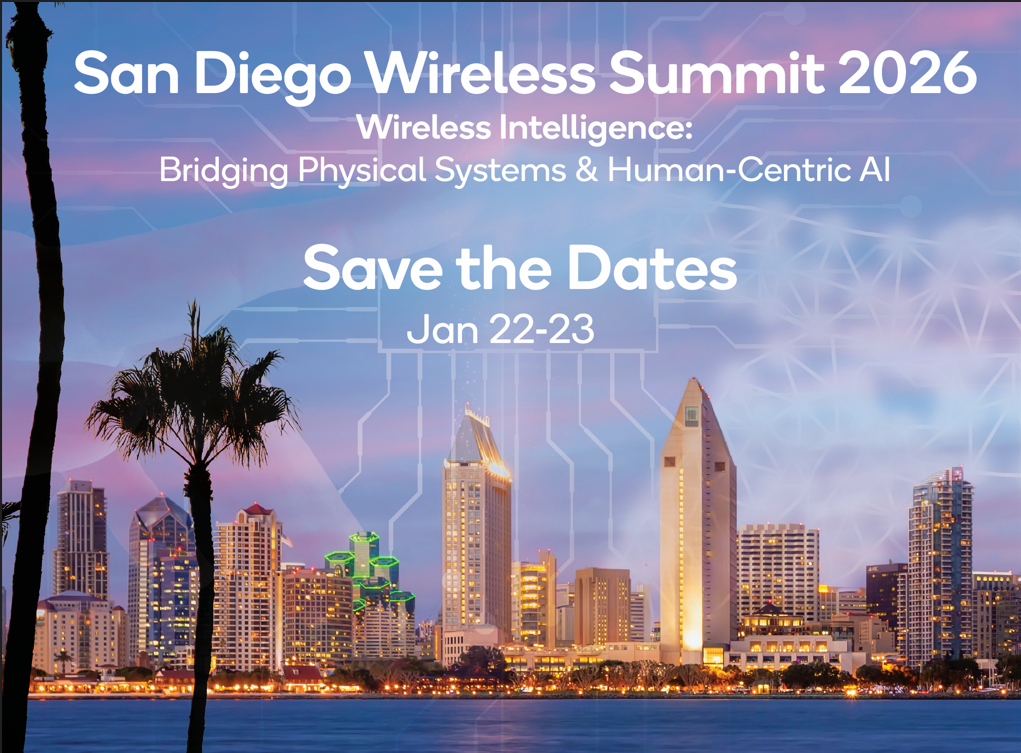


San Diego Wireless Summit 2026
Join us at the San Diego Wireless Summit (SDWS), hosted by the Center for Wireless Communications (CWC) and Qualcomm at UC San Diego. This exciting event will take place on January 22 & 23, 2026 at Atkinson Hall in UC San Diego.
In this year's Summit, "Wireless Intelligence: Bridging Physical Systems & Human-Centric AI", participants across industry and academia will come together to discuss challenges, innovations and opportunities arising from the Applications of Physical AI, the Network Infrastructure and related technology for Physical & Personal AI.
The summit includes keynote speeches, presentations, panel discussions as well as industry demonstrations and poster sessions from Academia.
Join us as we collectively shape the future using the powerful convergence of “Wireless Intelligence: Bridging Physical Systems & Human-Centric AI”!
Abstracts for the tracks:
Physical & Personal AI - Technology and Use Cases
Recent advances in AI and machine learning are creating a tangible expansion from the digital domain to the physical world and personal human experience. Physical AI and personal AI represent the next significant paradigm shift in AI, moving beyond static algorithms to dynamic, embodied intelligence that interacts directly with our environments and personal lives. This session will explore the key technologies and use cases driving this evolution. We will examine transformative use cases across multiple sectors including robotics and humanoids, drones, AR/VR glasses, and personalized digital assistants. To address the requirements and challenges associated with these applications, the session will also discuss foundational technologies such as multimodal foundation models, next-generation robotics platforms, efficient edge and network computing, and the role of wireless communication networks.
Network Infrastructure and related technology for Physical & Personal AI:
AI systems that act (Physical AI) and delegate (Personal AI) demand networks optimized for application-aware, task-level QoE, going beyond QoS. Beyond latency/throughput, what matters is time-to-action, safety margins, smoothness of control, and energy per task (Physical AI), as well as goal-completion rate, intent fidelity, responsiveness, transparency, security and privacy budgets (Personal AI) — much more of application dependent metrics.
A core design goal of this session is to imagine future devices, by devices we mean robots, wearables, phones — shifting heavy compute tasks — perception, planning, and memory to elastic edge or cloud compute. The network must therefore do more than carry bits: it must steer compute within the communication constraints. We’ll examine architectures that unify cloud — edge — device with programmable RAN/Wi-Fi and TSN/DetNet, in-network acceleration (DPUs/SmartNICs), and QoE driven offload (partitioning, model selection, speculative inference) with autoscaling across GPUs/NPUs at the edge. We would invite speakers that provide challenges across these use-cases and application — specifically that ties application targets to compute placement and radio/resource allocation.
Through case studies — humanoids/co-bots, autonomous systems, surgical robotics, and memory-centric Personal AI — we will hope to propose reference scenarios and platforms and show how compute elasticity plus device simplification yields faster, smoother operation with stronger safety and privacy. The session would close with a testbeds roundtable to align on evaluation methods that go beyond QoS and directly optimize for application outcomes.
Radio:
Research in radio technologies is entering an exciting era, with breakthroughs poised to redefine the capabilities of wireless networks for 6G and beyond. This session will showcase the latest advances in areas such as full duplex and Giga-MIMO architectures, next-generation antenna systems, and innovations in coding, modulation, and waveform design. Presentations will address scalable solutions for heterogeneous device ecosystems, uplink capacity and coverage enhancements, and strategies to eliminate bottlenecks for consistent user experience. Emerging technologies bring opportunities for enabling new network services such as integrated sensing, the transition to AI-native wireless architectures, and the development of user-experience-centric protocols and designs. We will provide technical insights into recent research, system prototypes, and deployment approaches that are shaping high-capacity, adaptive, and intelligent radio access networks—laying the foundation for transformative user experiences and services in future wireless ecosystems.
Circuits:
Artificial Intelligence (AI) has been heralded as the next revolution in circuit and system design—but is it delivering real value or just riding a wave of hype? Despite bold claims of enabling high-performance systems from low-performance circuits and optimizing power management at the edge, evidence of tangible benefits remains thin. Much of the narrative feels driven by marketing rather than measurable engineering outcomes. This session surveys the current state of AI in circuit design and invites a candid panel discussion: Are these techniques genuine innovations, or simply a techbro-fueled mirage distracting us from proven design methodologies?

CWC Director
Professor
Head of Wireless Research & Senior VP of Engineering
Qualcomm
Summit Planning & Coordination Team
UCSD
- Billiekai Boughton
- Dinesh Bharadia
- Sujit Dey
- Gabriel Rebeiz
- Ian Galton
- Xinyu Zhang
Qualcomm
- Emma Lacey
- Chengjin Zhang
- Lola Awoniyi-Oteri
- Taesang Yoo
- Bibhu Mohanty
- Jing Jiang
- Kiran Mukkavilli
- Jeremy Dunworth
- Alex Tu